EBL Models
The EBL module come from the ebltable git repository (see https://github.com/me-manu/ebltable)
Supported Models
Currently there is 5 models supported :
- Franceschini, A., Rodighiero, G., & Vaccari, M.2008, A&A, 487, 837 . http://adsabs.harvard.edu/abs/2008A%26A…487..837F
- Finke, Razzaque, & Dermer, 2010, ApJ, 712, 238 . http://adsabs.harvard.edu/abs/2009arXiv0905.1115F
- Dominguez, A., Primack, J.R., Rosario, D. J., et al. 2011, MNRAS, 410, 2556 . http://adsabs.harvard.edu/abs/2011MNRAS.410.2556D
- Inoue, Y., Inoue, S., Kobayashi, M. A. R., et al. 2013, ApJ, 768, 197 http://adsabs.harvard.edu/abs/2013ApJ…768..197I
- Kneiske, T. M., & Dole, H. 2010, A&A, 515, A19 http://adsabs.harvard.edu/cgi-bin/bib_query?arXiv:1001.2132
Each model is read using
from ebltable.tau_from_model import OptDepth as OD
tau = OD(model = 'inoue')
# Source redshift
z   = 0.2
# array with energies in TeV
ETeV = np.logspace(-1,1,50)

# calculating the optical depth for a redshift z and TeV energies
# this returns a two dimensional array with dimensions
# of the redshift array times dimensions of the energy array.
# Since z is a scalar here, it will return a 1 x 50 dim array.
t = tau.opt_depth_array(z,ETeV)
Flux correction
For correction of the flux, you can then compute
import numpy
correction = numpy.exp(-1. * t[0])
Example
The example script can help to understand and will produce this plot
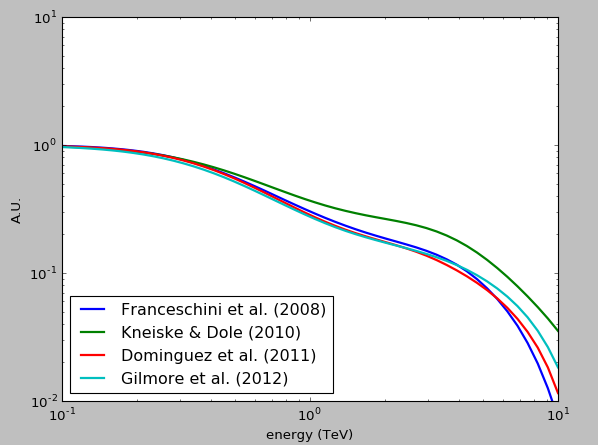
Exemple of flux in A.U. corrected with the supported models. This plot has been generated by the script ExempleEBL.py